

KT 131: Chronicle at CaSFFA
A newcomer writes on one of the films screening at the Czech & Slovak Film Festival
Chronicle
Martin Kollar, 2025
Screening at the Lido di Hawthorn at 1.15pm on Saturday as part of the Czech & Slovak Film Festival. The film will be accompanied by Nora Štrbová 2025 short film, What If We Run Out of Stones.
Tickets here
Listings Calendar here.
Words by Jamie Tak
I watched Chronicle (Letopis; 2025) on my living room floor, all the windows flung wide open. On this day it was unseasonably warm. I lay prostrate as a rolled rug on the tiles: my laptop across me, and a glass of juice. There I stayed for the length of the film—skin sticky, elbows aching, gaze held by the screen. For 71 such minutes I let it make an anthropologist out of me.
Chronicle is the second feature film by director Martin Kollar, who predominantly works as a photographer and cinematographer. An observational essay, it was filmed with a bare-bones crew over the course of some eight years in his native Slovakia. Almost entirely composed of long, static takes of assorted human environments, the film patchworks a meditation on contemporary society.
Its primary concern: human labour. An abattoir worker hauls dead pigs into steel tubs; their limp bodies drop like baby-pink bolster pillows. Scientists collect stagnant water into thin, finger-like vials. Bricks are laid, fingerprints are taken, buildings are demolished. No narrative threads one shot to the next; each stands alone, harvested from its own space and time. Kollar bleeds these moments into each other, to flow as an absurd river.
Much of Chronicle was planned and written with Kollar’s late partner and filmmaker Mária Rumanová, to whom the film is dedicated. This was to be their second collaborative project together. Two years after her death, Kollar published a short photobook titled After. In the wake of Rumanová’s passing, he had revisited images from their shared photographic archive, only to find them unrecognisably transformed by her departure: “Everything has changed. Maria’s untimely death, her decision to end her own life, has made a distinct cut, a sharp delineation of the before and after.”
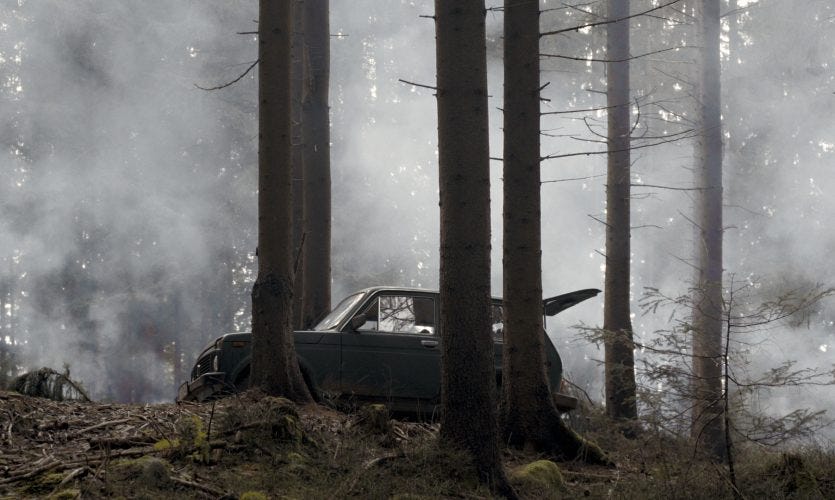
The film, too, feels something like a reinterpretation of the world along the winding path of grief. Its images drift along a faint chronology, tracing the passing of time through the turn of the seasons. We begin with a blizzard, and end with the thrum of cicadas studded along a thicket of trees. We observe a reluctant thawing, an allowance of acceptance.
In life’s ruptures we look nervously toward the referent of the everyday. It becomes something to obsess over, as we grasp at the quotidian to find form in the misshapen. Lefebvre situates the everyday at the intersection of two modes of repetition: ‘the cyclical, which dominates in nature, and the linear, which dominates in [manmade] processes known as rational’. In Chronicle, these modes engage in a kind of dialectical scrimmage, made manifest by the contradictory rhythms of the natural and manmade world. In this way, the film can be somewhat crudely understood as a string of conflicts between the work of man and nature. In places emerge a rivalry that feels almost slapstick, and I am reminded of a Tom and Jerry chase.
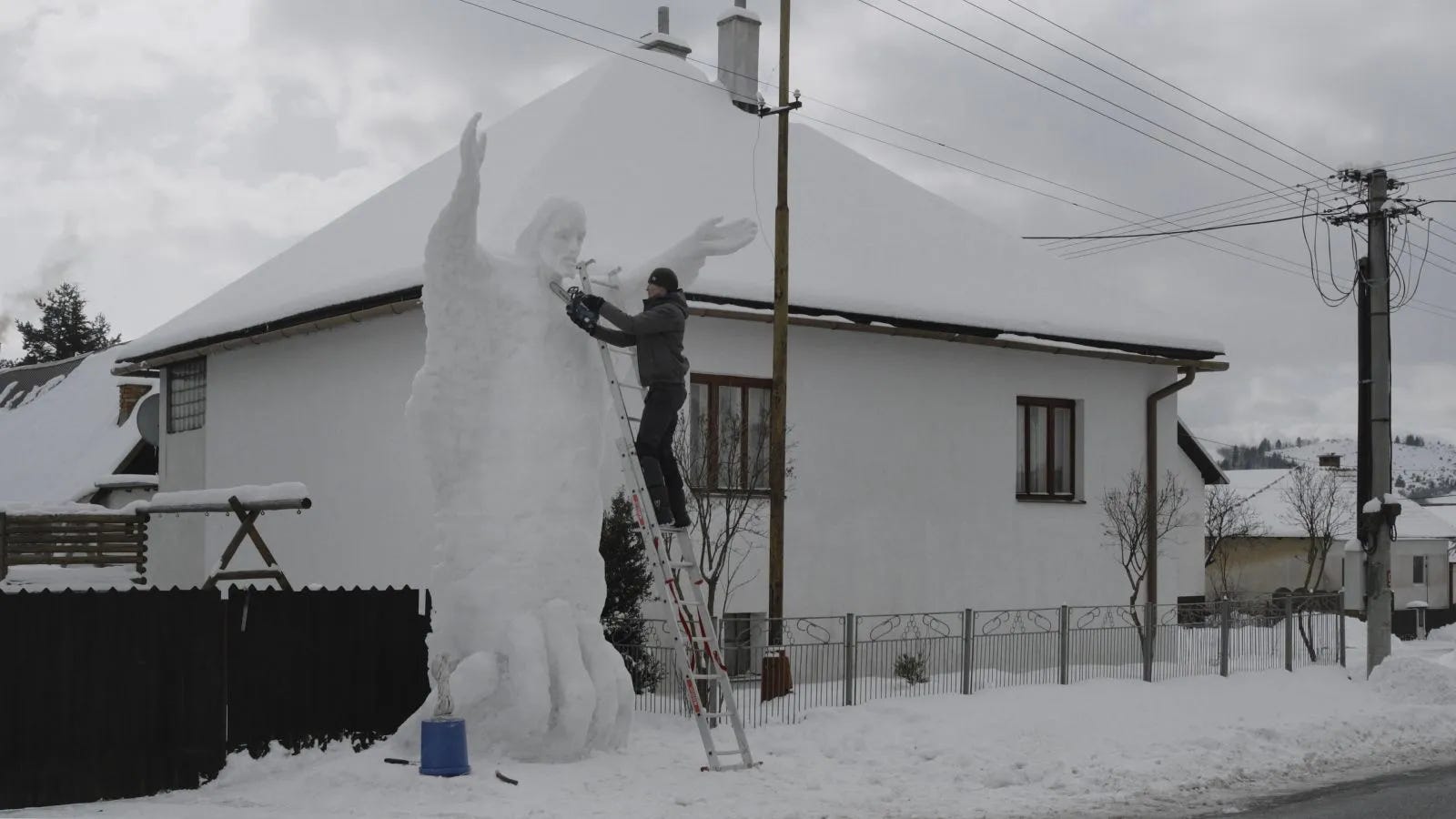
An early scene finds a town completely enveloped by snow, like a heavily iced concrete cake. A woman wanders, confused, through a parking lot of cars, each an enormous, unidentifiable mound of white. A couple attempts to rake snow from their rooftop. Their metal swishing is swallowed by a great gust of wind, depositing more snow on the house.
Of the film’s myriad sequences, I was most arrested by a short scene of a falcon tied to a perch. The bird repeatedly tries to fly, only to be yanked straight back by the cord at its ankle. Allowed only a tiny circumference around the perch, it is sentenced to an eternal walking around and around. Poor winged creature. What could you know of mundane repetition.
I have never been to Slovakia, yet Chronicle felt to me an intensely familiar observation. All forms of labour can agonise in their alienation. We toil, we relentlessly reassure ourselves: I am working, I am working towards something. By my afternoon object of leisure my exercises of labour feel understood. We all are working. We all tell ourselves we are working towards something.
The film closes with scenes of people at rest among nature. All is forgiven, because it is summer. On a field, there is a picnic. A girl slathers her boyfriend’s back with sunscreen. A bus driver sunbathes next to his vehicle, his bare feet in the air. A man swims in a river of tadpoles, while another sleeps on the ivy-swaddled root of a tree, his retriever beside him. Sunlight frolics on their eyelids. Today, all this leisure. Tomorrow, work. The bus must run. The shoes go on. The dog awaits his owner’s return. And we continue to negotiate with everydayness, pleading time.
Listings are changing:
We’re in the midst of changing our listings into calendar form.
For now we’ve opted for calendar on Google docs that you can save and check on the go. It will be updated weekly and potentially daily we see something interesting pop up.
Please save this link to see our calendar all the time.