

137: Nuremberg
F.D returns to one of history's most devastating chapters
→ Updated Listings Calendar here ←
Nuremberg
James Vanderbilt, 2025
Screening at most ‘plexes
Words by Finn Devlin
Despite the focus of James Vanderbilt’s Nuremberg zeroing in on a unique point of history, any WWII film forfeits the right to be lauded sui generis. Yet for an entry into a genre with a record longer than many of the Nazi High Command, by finding its home in the post-war courtroom, it walks its own path in a forest defined by its beaten track.
Make no mistake, this is an ugly film. Digitally inserted rubbled buildings barely stand out amongst a greying, unimaginative colourscape, one that owes itself as much to the decline of the on-screen colour palette and rise of the ‘tech bro’ aesthetic, as much as it does to any kind of creative cinematography. Conceptually, ugliness is the point: attempting to peek behind the curtain at the man behind the killing, delving into the mind and motivations of someone who is oddly, one of pop culture’s least notorious Nazis.
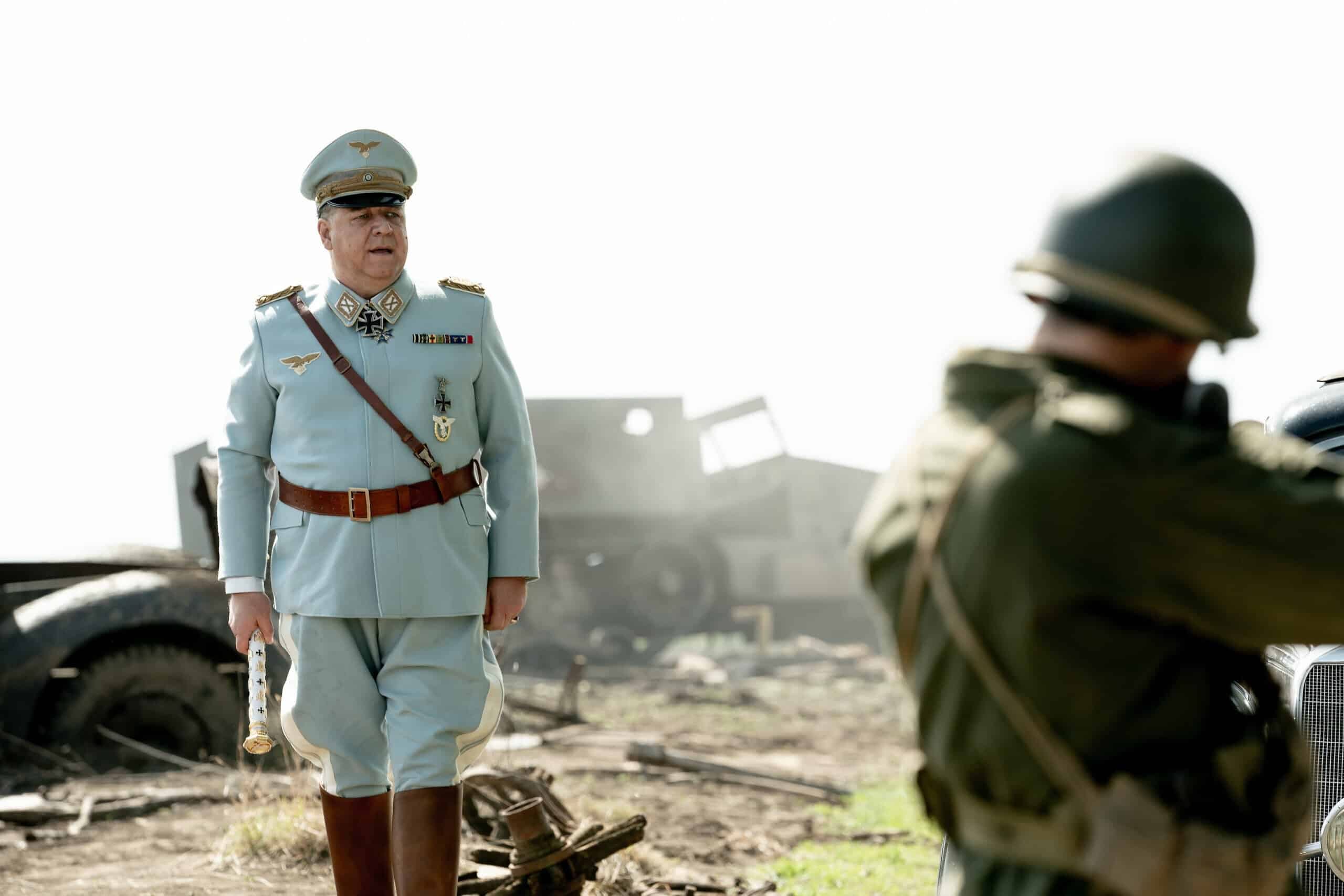
In this sense, Nuremberg plays its part in the historical documentation of history’s worst atrocities. Its fundamental point of difference is that it looks into a black hole of 21st century history: the years immediately following the great war.
This is a natural blindspot in Western lore. Given the modern world was born of this conflict - which was followed by 30 years of near-uninterrupted economic growth, the invention of the welfare state, the creation of numerous actual states, the Cold War, the rise of neo-liberalism, the collapse of the USSR, the invention of the internet, the global financial crisis, the birth of social media, the decline of the US hegemony and the the meteoric rise of China, the rebirth of western neo-fascism, COVID, the largest land war in Europe since the beginning of the modern age, and one the fastest and most intensive displacement and exterminations of a populace in modern times - it’s easy to forget that there were a few years following the fall of Berlin where our current trajectory wasn’t set in stone.
To its core, humanity was still in shock at what it could unleash upon itself. Broke and broken, in every sense we found ourselves at a crossroads, defining the future with little cash and few guardrails, and the true horror of what organised, fanatical, ideological, systemic violence could unleash upon all humankind not yet appearing in the rearview mirror.
It’s this point that really defines what Nuremberg sketches out for us: the height of the stakes of the trial of the Nazis, something lost to time. There was no United Nations, no international law, no peace to uphold. The only order was the old order, the defeated order and the one that would replace them both. In other words, by trying the Nazi high command in an international court of law, we were inventing the guardrails of the next peacetime.
The Western world revels in lionising the result of this successful trial of the Nazis - a framework for international law and the first ever significant set of legal frameworks to prevent such mass extermination of life from being bequeathed upon us. And it deserves some credit, it is a point lost that - in economic terms at least - a system of order, a court and law for states and the imposition of mass diplomacy and bureaucracy has seen a good portion of the world gain access to a significantly higher standard of living than has previously been considered possible, mostly because we aren’t burning everything down twice a century using increasingly globally-scaled tools, and instead focusing on chasing profit at all costs, including life.
That only tells half the story. Nuremberg showcases the bright side of the Western world, one where it is possible to hold accountable those who commit atrocities upon their fellow man. The second half is steeped in what much of the rest of the world correctly labels ‘western hypocrisy’. It’s all well and good to impose an order on the world that borrows heavily from the principle rule of law, steeped in the ‘individual freedom’ of self-determination and guided by the glorious democratic project. But the success of this depends muchly on the states responsible for its imposition actually following these principles.
Trace the timeline since the heady days of holding Hitler’s cronies to account for their slaughter, and a darker, far more sinister pattern emerges: the hijacking of these courts, systems and principles to maintain in unbalanced and inequitable global order where wealth is funneled upwards, slowly choking humanity until such systemic violence seems to be the only agent of change, which is all the pretext those in control of the global order need to reign hell down upon people daring to self-determine.
Iran, Iraq, Afghanistan, Syria, Lebanon, Egypt. The Koreas, Vietnam, Cambodia, Laos, Indonesia, Guatemala, Haiti, Cuba, the Dominican Republic, Chile, Brazil, Bolivia, Guyana, Costa Rica, Greece, Italy, Albania, Russia, Congo and Ethiopia are all victims of the order that replaced the war. How many lives have been laid waste in the name of what we call peace? How many more have been ruined? All for the upholding of the fabled global order.
It would be remiss not to mention the psychological examination of Hermann Goering in Nuremberg, a character well suited to Rusty’s mid-to-late-career portrayal of large personalities with foreign accents in films with smaller budgets than yesteryear. The gradual breakdown of Goering’s wall provides details of character that are unique to this film.
Rusty’s performance is a balance of arrogance, dominance, mixed with a foggy helplessness and undercut by a chilling aloofness to the gravity of his conduct, that lends much of the dialogue significant weight. An extra point is due for nailing the German accent, despite my yearning for a truly cartoonish Rusty Germania. The baby blue uniform will have to do.
Ultimately, the plot of the film is about holding accountable some of history’s worst men and Rusty steps up to this lofty bar, delivering a performance that helps lift the veil of decorum that often covers the depravity of evil.
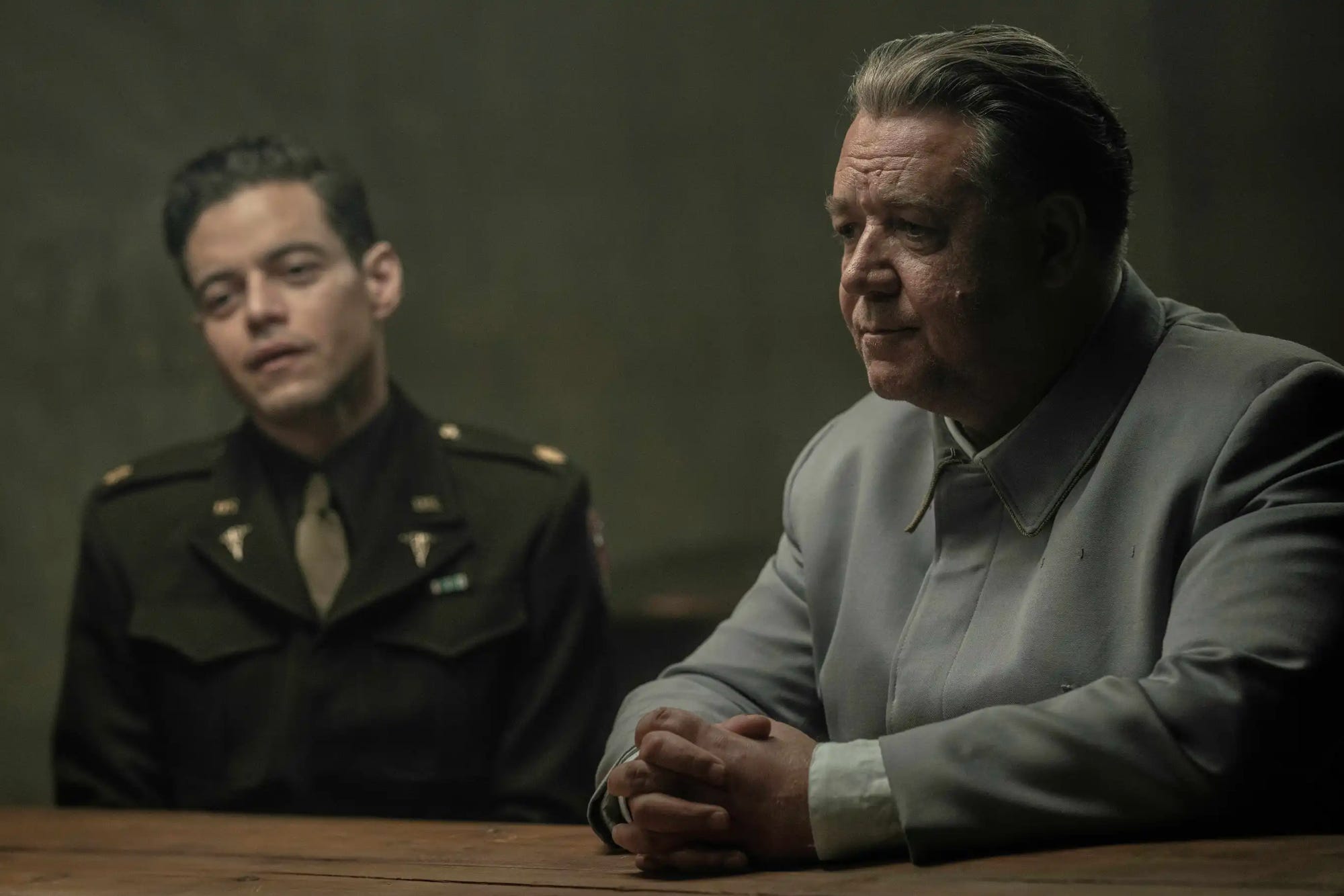
It reminds us that we remain in search of a better tomorrow, and in that vein, it is my sincere hope that some day in a better, more just world, we can convene a court to hold one of history’s worst actors - Rami Malek - accountable for his many crimes against the profession. But that day remains long in the future, so until then, the best I can say is that the drawling and dreary nature of his character - the American shrink Douglas Kelley - meant that in this case, we were saved from having to watch him actually act. All he had to do was be himself.
I’ve long felt courtrooms can be risky places to take films, albeit with some outstanding exceptions. The real-world dryness of the bureaucracy of justice bleeds itself into the silver screen, often making the audience feel more like they’re sitting in the back of a dreary Melbourne Magistrates courtroom on a high school excursion that everyone - teachers, judges and defendants included - could have done without.
Nuremberg just about avoids falling into this trap, and with its examination of the birth of modern global governance, and a psychological examination of one of history’s worst men, it breeds a new snarling humanity into an ideology that has had its nuances have lost to time. Miraculously, it forges its own path in a genre where many have walked the same line a million and one times before.
WE ARE SEEKING LETTERS
We’ve made our share of lovers and haters in our near 3-years of operation. As part of a special project we’re working on, we’d like to hear from you.
Too many spelling mistakes in our pieces? Our opinions straight up wrong? Got a feeling the reviewer has barely watched the film or a film in general for that matter? Let us know.
Or want to complain about the constant guttural coughing at CTEQ, the cost of popcorn at Hoyts, the sight-lines at certain cinemas or maybe some ushers being a little too big for their boots? Also let us know.
Conversely, if you want to praise us on our unwavering commitment to screen culture in this great city. Or commend our championing of emerging writers. Or comment something even vaguely positive. Please write in.
Respond to this email or hit us up via emails or IG with your thoughts.
LISTINGS + WEEKLY UPDATE
Please find our comprehensive weekly listings via the link at the top of this article and also here.